


Why You Never Check Your Ski Boots When Flying
There is one item on your ski trip that cannot be replaced.
It isn't your skis.
It isn't your jacket, your goggles, your gloves, or the four base layers you overpacked and never wore.
It's your ski boots.
Skis can be rented at the base of every mountain in North America. Jackets can be borrowed. Goggles can be bought in the lodge for a price that will annoy you but won't ruin your weekend.
Your boots are the one piece of gear on the trip that was shaped to your feet. Punched, ground, heat molded, footbedded, adjusted over a season or three until they finally stopped hurting.
That is one item you cannot rent.
So when people ask us why we're so aggressive about this, the answer is short. Checking your ski boots is the single highest risk decision you can make on a ski trip. And it's completely optional.

The math on lost luggage is worse than you think during ski season
In 2025, 24 million bags were mishandled. That includes bags that were delayed and lost.
That's a lot of impacted trips. And although airlines are (slowly) getting better, the improvement is't even:
1. Connections are where bags die.
Transfers accounted for 39% of all mishandling cases in 2025. Now think about how you actually get to a ski town. Very few of us fly nonstop into Bozeman, Jackson, Hayden, or Kalispell. Most of us connect. Ski travel is transfer-heavy travel by definition, which means ski travel is disproportionately exposed to the exact failure mode that mishandles bags most often.
2. Your season is their worst season.
Baggage industry data consistently shows December, January, as two of the months when luggage is mishandled most often. Your biggest ski trips are an airports worst nightmare.
You are flying through the worst-case window, on the worst-case routing, with the one item you cannot replace. The likelihood of losing checked gear on a ski trip is much higher than on your average travel day. There's a reason skiers fear checking their boots as much as they fear rain in the forecast.

Compensation does not get you on the chairlift
The other thing people say to us is that they're covered.
They're not. Well, not in the way that matters.
Airline liability for lost or damaged bags on domestic US flights is capped at $4,700 per passenger, and delayed bag fees are only refundable once your bag is more than 12 hours late arriving at the gate on a domestic flight.
Read that again with a weekend trip in mind.
You landed Friday night. You have Saturday and Sunday. If your bag shows up at hour 13, the airline has "technically" done its job and you have literally lost half your trip. A reimbursement form does not put you in the lift line at 8:30 on Saturday morning. It just tells you, in writing, that you were right to be annoyed!
Not to mention, you have to help coordinate getting the ski boots from the airport to your hotel - which isn't always easy.
This is what our customers keep telling us in reviews, in almost exactly the same words. Here is one of our favorites:
"It's insurance that you can still go skiing, even if your main bag is delayed. Which has actually happened 3 out of the last 5 trips."
That's the whole product thesis in one sentence. The boots go with you. Everything else can be late.
The weekend warrior problem
At its core, the Weekend Warrior was designed for, well, the weekend warrior.
The person flying out Thursday night after work, skiing Friday and Saturday, and sitting on a Sunday evening flight home with wet gear and a Monday morning meeting. You have two ski days. Maybe three.
If you're a weekend warrior, a delayed bag ruins the trip. There is no buffer in that schedule, no rest day to absorb a baggage problem, no rental shop visit that fixes fitted boots.
The weekend warrior has the least margin for error of anyone on the mountain, and somehow ends up with the least specialized gear for it.
So the rule is simple:
Boots, helmet, goggles, and your on-mountain layers go in the overhead bin.
The rest can get checked. You can rent skis, purchase lost clothing, and so on. But you can't replace skiing on your own custom fitted boots.

What a "TSA approved ski boot bag" actually means
We use this phrase often and realize some people wonder it actually means so here goes:
The TSA does not certify or approve luggage. There is no stamp. What people mean when they search for a TSA approved ski boot bag is a bag that fits standard carry-on size rules, clears security without drama, and goes in the overhead bin instead of down the belt.
That distinction matters, because most ski boot bags on the market fail to get onto the airplane with you. They were designed for the trunk of a car and the walk from the parking lot, not for a boarding gate.
The Weekend Warrior 2.0: our carry-on ski boot bag

Aka our solution.
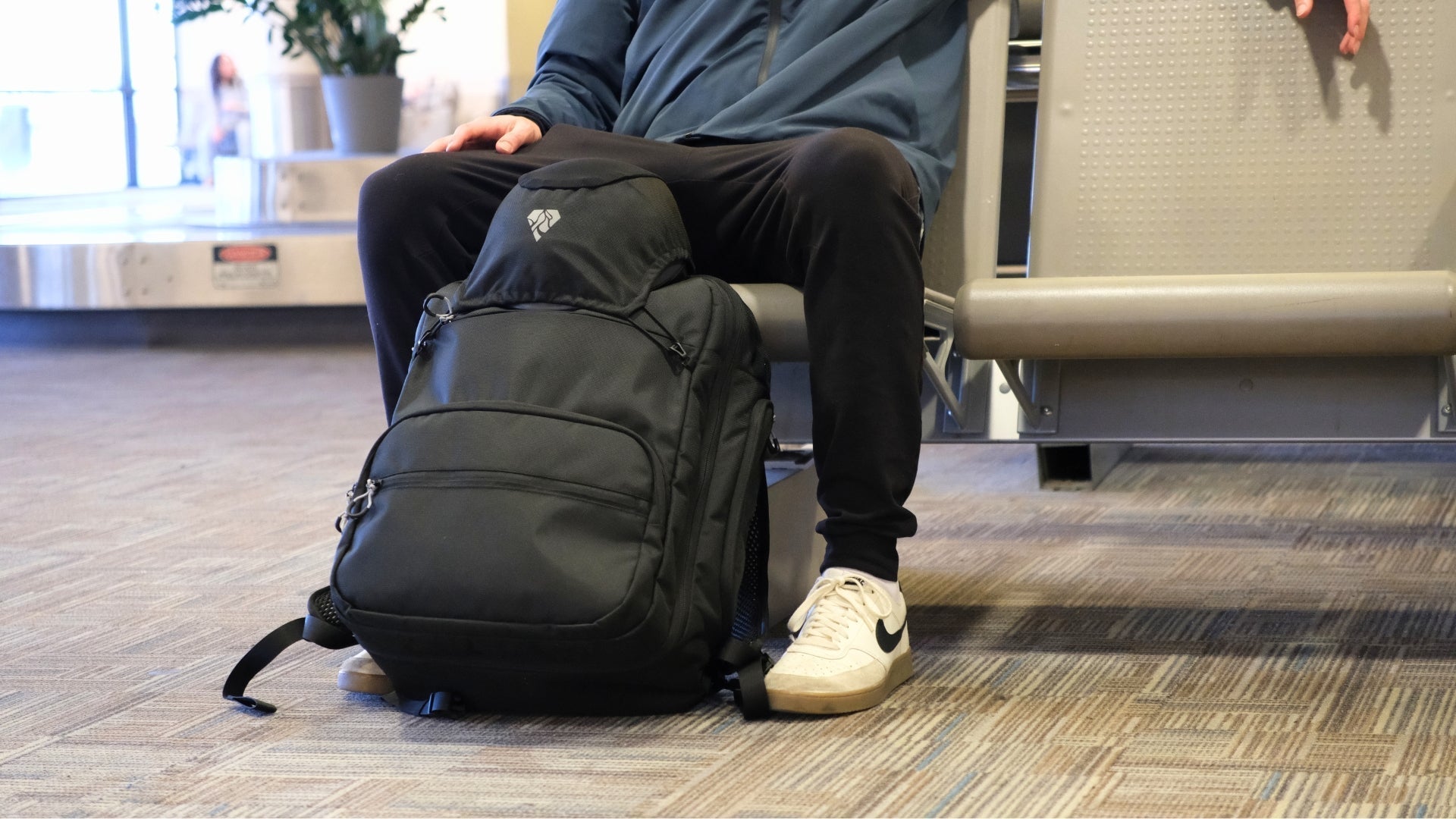
The Weekend Warrior 2.0 is our answer to a carry-on ski boot bag that fits in the overhead.
It's a ski boot bag backpack that fits the overhead bin worldwide. Both in the 40L and 50L. The boot compartment is fully separated, tarpaulin lined, water resistant and ventilated, so your wet shells aren't sharing space with your laptop and your clothes. There's a padded goggle pocket, a padded laptop sleeve, dedicated pockets for on-mountain gear, and a helmet canopy on the outside so the helmet rides with you instead of getting crushed inside.
The 1680D ballistic exterior with a weatherproof coating handles slush, snow, and being set down in a parking lot. There's an AirTag sleeve, because of course there is.
A few more notes about the bag:
It's a carry-on, not a personal item. Packed light, the 40L will slide under a seat. Packed the way you're actually going to pack it, with every pocket used, plan on the overhead bin. We say this because the opposite expectation is the single most common complaint in our own reviews, and we'd rather lose a sale than earn a three star.
Fully loaded, it's 20 to 28 lb on your back. Plenty of people carry that through airports and train stations without thinking about it. Some don't want to. Which brings us to the other bag...
The XL: same thinking, on wheels

If carrying twenty-something pounds through a connection at DEN doesn't appeal to you, get the wheels.
The XL is our roller ski boot bag. 60L, 22.7" x 15.5" x 9.5", still built to carry-on dimensions. Winterized wheels that actually roll on snow, slush, and cobblestones instead of seizing up. Same tarpaulin-lined ventilated boot compartment, sized to fit up to a Mondo 32 boot or the snowboard equivalent, plus a 20L clothing compartment, the goggle pocket, the helmet canopy with two placements, the 1680D ballistic shell, the AirTag sleeve.
It's the pick if any of these sound like you:
- You pack more than two days of clothing
- You have big feet or big boots and you're tired of bags that almost fit
- You'd rather roll than carry, especially through long airport walks and transfers
- You're the family member who somehow ends up carrying everyone else's stuff
- You have back pain
Backpack or roller, the strategy is identical. Boots in the overhead bin. Skis on the belt. You ski tomorrow no matter what the baggage system does tonight.
Quick answers
Can you carry on ski boots? Yes. Ski boots are allowed in carry-on baggage. The constraint is size, not security, so what you need is a boot bag that fits carry-on dimensions and goes in the overhead bin.
Do I have to check my ski boots if I'm checking my skis? No, and you shouldn't. Most US airlines count a ski bag plus a boot bag as a single checked item, which is exactly why so many people check both out of habit. Check the skis. Carry the boots.
Is a boot bag one of my two carry-on items? Treat it as your carry-on and keep a small personal item separate. Airline policies vary and change most seasons, so confirm with your carrier before you fly.
What about wet boots on the plane? Pull the liners at the end of your last day so both liners and shells can air out, then pack them in a bag with a separated, ventilated boot compartment. That's specifically what the tarpaulin lining is for.
Backpack or roller? Weekend trips, light packers, and anyone who doesn't mind the weight on their back: the Weekend Warrior 2.0. Bigger boots, longer trips, heavier packers, or anyone who'd rather roll: The XL.
Shop the Weekend Warrior 2.0 | Shop The XL
See you out there.
-Shai
Leave a comment
This site is protected by hCaptcha and the hCaptcha Privacy Policy and Terms of Service apply.